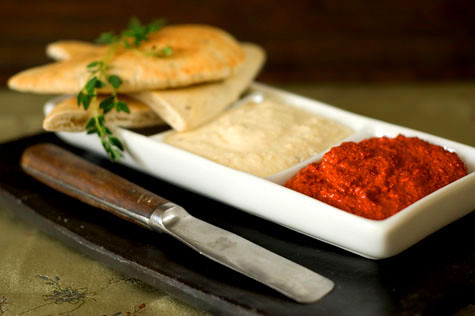
Turkish Delights

turkishdips2.jpg
Muhammara (Red Pepper, Walnut and Pomegranate Dip)
and Tarator (Pine Nut and Garlic Dip) 

 
Last year in late spring, with the tiresome cold of a northern European winter having driven us to the point of madness, Manuel and I made an impulsive decision to spend a week in Turkey. It was really just luck that brought us to this destination, as we would have gone practically anywhere with sun and a place to lie supine beneath it, but a particularly good last minute deal to this country we had both been long eager to visit practically fell into our laps, and before we even had a chance to think twice, we had packed our bags and hopped on a plane.

Our itinerary took us to the southwest corner of Turkey – the area on a map where the coastline stops plunging south and takes a sharp left-turn to the east, an area stunningly beautiful but unsuitable for mass tourism because of its steep topography and lack of sandy beaches. We stayed in a small family-run hotel on a hill overlooking the town of Kalkan; below our balcony snaked small, serpentine streets leading down to the harbor, and beyond that – as if we were perched on the edge of the world – nothing but the crystalline waters of the Mediterranean stretching out to meet the horizon. The sun was shining, the locals friendly, the pace of life relaxed, the cold beers plentiful. There was something deeply, familiarly Mediterranean about the place – but at the same time it was tantalizingly foreign. This foreignness assumed many guises: the distant plaintive wail of the muezzin calling everyone to prayer at the break of dawn; the strange, incomprehensible writing on street signs; the markets, full of haggling and drama and unfamiliar products; the scent of tea and Nargile smoke wafting out from the interior of shops, and of course, in ways more spectacular than we could have dreamed, the food.

We both considered ourselves familiar with Turkish food from Germany, where Turkish take-out is as ubiquitous as McDonalds and only sometimes better tasting. In Turkey itself, the food was jaw-dropping. It exploded with freshness and the flavors of sun-ripened fruits, vegetables and herbs. We feasted on chicken stewed with cumin, pomegranate and orange; fish roasted with sumac; eggplant stuffed with spicy lamb and pine nuts; melting tomato salads doused with lemon and fresh dill. We ate rose-petal jam on thick, creamy yogurt for breakfast, candied pumpkin and spoonfuls of honey-soaked pistachios for dessert. We drank tart apple tea, salty yogurt aryan, and tiny glasses of syrupy coffee. And whenever everything looked so good that we simply couldn’t decide what to order, we ate mezze.

Dips, salads, vegetables, pastries and meat – mezze are the tapas of the Middle East, small plates that are meant as an appetite stimulant, an antidote to indecision, and an excuse to linger over your meal for hours. In Turkey and other countries of the Eastern Mediterranean they’re cheap, plentiful, and about as authentic as food gets; they’re also one of the easiest ways to recreate a Middle Eastern feast at home. A few fragrant salads, some marinated olives and peppers, some spicy lamb kofte, warm pita bread and these hauntingly delicious dips, and you have a meal fit for a sultan. Though it can’t replace the magic of actually being there again, at least for this there is no last-minute packing required. 

Note: both of the following can be used as dips for bread, as a sauce for vegetables or as an accompaniment to meat or fish. 

Muhammara (Red Pepper Dip with Walnuts and Pomegranate)

Source: adapted from Paula Wolfert’s The Cooking of the Eastern Mediterranean
Yield: 3 cups 

2 1/2 lbs. red bell peppers
1-2 small hot chilis, or 1/4 tsp cayenne pepper
1 1/2 cups walnuts
1 tablespoon fresh lemon juice
2 tablespoons pomegranate molasses, or more to taste
1/2 teaspoon ground cumin
3/4 teaspoon salt
1 teaspoon sugar
2 tablespoons olive oil 

For best results, make the recipe at least one day in advance.

Roast the bell peppers and the chili, if using, over hot coals, a gas burner, or under the broiler in the oven, turning frequently until blackened and blistered all over, about 12 minutes. Place in a covered bowl to steam for ten minutes, then rub off the skins. Slit open the peppers and remove the stems, membranes and seeds. Spread the peppers on paper towels and let drain for at least ten minutes.

In a food processor, grind the walnuts, lemon juice, pomegranate molasses, cumin, salt and sugar until smooth. Add the peppers; process until pureed and creamy. With the machine on, add the olive oil in a thin stream. If the paste is too thick, thin with a tablespoon or two of water. Taste and add more pomegranate molasses, salt or sugar to achieve a good balance between sour, sweet and salty. Refrigerate overnight in a covered continer to allow the flavors to blend. Serve at room temperature.

Tarator (Pine Nut and Garlic Dip)

Source: adapted from Paula Wolfert’s The Cooking of the Eastern Mediterranean
Yield: 1 3/4 cups 

1 cup pine nuts
2-3 fat cloves garlic, minced
1/2 cup water
2 cups stale crustless bread, soaked in water and squeezed dry (to make about 1/2 cup packed)
3 tablespoons vinegar or lemon juice
salt to taste
2 tablespoons olive oil

2 tablespoons plain or Greek yogurt (optional) 

In a skillet or oven, heat the nuts until they just start to turn fragrant and golden, watching closely to make sure they don’t burn. Place them in a food processor with the garlic and 1/3 cup of the water; process until smooth. With the machine running, add the bread, vinegar, salt, and the oil; process until well blended. Add the remaining water to loosen the mixture. If a slightly creamier texture is desired, add a couple tablespoons of yogurt. Transfer to a bowl and let mellow for at least two hours before serving, or up to a day.


Dulce de Membrillo, and a (Host) Mother’s Love

quesomembrillo.jpg
Queso (in this case an artisan Grimbester from the Orkney Islands)
and Membrillo (Spanish Quince Paste) 

My Spanish host mother Clari was one of the most enigmatic women I’ve ever known. Small, dark and rotund, with piercing coal-black eyes and an encroaching colony of facial hair, she was – despite the purplish shade of hair dye she used (which seemed to be de rigeur among brunettes the year I was there) – no shrinking violet. She could in fact be fiercely intimidating, the gruffness in her voice accentuated by decades of smoking Lucky Strikes, her orders taking on a military severity as she barked them to her wayward children. Her emotions were hidden behind a hard-as-nails exterior, occasionally belied by a softness of voice but never expressed overtly to either her spouse or children. It was quite disconcerting to a household newcomer like me, but everyone else seemed to take it in stride. It was with great surprise, then, that after living with her for a short time I discovered that not only did an unguarded back door to her affections exist, but that finding it was as easy as picking up a fork.

Within my first week of living there, I had figured out how things worked in Clari’s household. She cooked, people ate. There was no discussion about what was for dinner, no special requests taken or pickiness tolerated. Whether she produced a pot of beans or a perfectly baked fish, her family was expected to eat and be grateful. The problem was that they never were. "Why can’t we ever have Telepizza?" my two younger host siblings would complain daily. "Why do you need to use so much garlic?", my older host sister would chime in, pedantically redirecting the crispy fried slices to the rim of her plate. "I think you used too much salt this time," my host father would mumble, pouring himself more wine. Clari would just sigh deeply, shrug her shoulders, and turn to me. "Would you like more Melissa?"

Of course I did. Her food was incredible, cooked as much by instinct as by experience, and somehow she always managed to take the best part of an ingredient and turn it into a better, more exciting version of itself. Simple vegetables had me practically licking my plate; lentils found their way into my dreams. I don’t know why her own children insisted on drooling over pizza commercials, but in my limited culinary experience this ranked up there with the food of the gods. And this isn’t even taking dessert into account.

Although we had dessert every day there were usually only three options: yogurt, fruit, and nuts that you had to crack open yourself. Every once in a while there would be something special – a bar of chocolate, containers of sugary Petit Suisse, homemade vanilla custard, or less popular with my siblings, a wedge of pungent sheep’s milk cheese and a slice of something called membrillo. I’ll never forget the day Clari brought the cheese and membrillo out the first time and smiled at my quizzical look. "This is something very typical of our region," she said, "it’s cheese made with sheep and goat’s milk, which we like to eat with dulce de membrillo." "Dulce de what?" I asked. Membrillo, she explained to me, was a fruit something like an apple or a pear, but very hard – you could only eat it cooked, and when it was cooked with sugar to a firm paste it was called dulce. I shrugged – I had no idea what fruit she was talking about, and even after pausing to find the translation ‘quince’ in the dictionary, I was still just as clueless.

She cut me a thick, ruby-red slice from the long slab of membrillo, and asked what kind of cheese I wanted with it. She had two, neither identified by name but just by type of milk and age, both having been cut from large rind-washed wheels. The kids were already reaching for the one marked tierno, a young cheese possessing a supple, creamy texture and mild but somewhat unremarkable flavor. "I’ll take that one," I said, pointing to the other, a cracked, golden wedge surrounded by wrinkled green rind, its pungent scent of sheep, wet floors and hay reaching me clear across the table. She exchanged quick glances with her husband before carving me off a wedge. "This is my favorite," she said quietly, "but I don’t know if you’ll like it. It’s very strong." My older host sister shivered, and turned her gaze away.

Clari showed me how to layer slices of membrillo and cheese of equal thickness together. "You could eat it on bread, but I think it masks the flavor", she told me. With everybody’s eyes following, I took a bite. I must have chewed thoughtfully, savoring the contrasts in texture and flavor and marvelling at how floral and fruity the membrillo was and how perfectly it subdued the salty, full-frontal-assault of the cheese. I don’t remember that though, I only remember it being gone, and requesting another slice of each. And another. And being vaguely aware of the corners of Clari’s mouth turning up again and again, every time I did. It wasn’t just good – it was revelatory.

From that day forward, there was always queso and membrillo in the house. After lunch, Clari would impatiently ask "what do you kids want for dessert?", there would be various calls for chocolate or Petit Suisse, neither of which she seemed to buy anymore. My host siblings would grumpily concede to a yogurt or an orange, at which point she would turn to me and say "and for you, Melissa, queso and membrillo?". Upon seeing my nod, her expression would soften and get a little wistful, and everybody at the table would wonder what kind of a spell I had worked on her to always get what I wanted for dessert. Somehow I could never bring myself to tell them just how easy it had been.


Dulce de Membrillo

Source: The Basque Table by Teresa Barrenechea
Notes: Dulce de membrillo is eaten all over Spain, usually served in restaurants with Manchego cheese and eaten either as a tapa or as dessert. In Portugal they make something identical which they call marmelada. It’s becoming increasingly available in the rest of the world, usually packed in small shelf-stable plastic containers, but honestly nothing beats it fresh. And it’s so easy! Also, if you’re lucky enough to be in possession of a large number of quinces, there have been a deluge of beautiful quince recipes posted around the blogosphere in recent weeks that look absolutely delicious. 

Special equipment: a scale

4 large quinces
sugar 

Wash the quinces, but do not peel them. Put them into a large pan, and add enough water to cover them by 1 inch. Bring the water to a boil over high heat. Reduce the heat to medium, and cook the quinces for about 40 minutes, until they begin to crack. With a slotted spoon, remove the quinces from the pan, and set them aside to cool.

When the quinces are cool enough to handle, peel them, and remove and discard the seeds. Weigh the peeled and seeded quinces, and then pass them through a food mill
or process in a food processor until smooth.

Transfer the quinces to a saucepan, and add the same weight of sugar as fruit. Stir well, and cook the mixture over very low heat for about 1 hour, stirring often with a wooden spoon, until the mixture turns red and very sticky, and there is no visible liquid left. 

Transfer it to a shallow container (a loaf pan works well for this), and let it cool uncovered. Cut it up when it has solidified, and serve it with slices of pungent cheese. It will keep in the refrigerator, tightly covered, for up to two months.


Generations of Crisp

applecrisp.jpg
Apple, Hazelnut and Vanilla Crisp 


The women in my family are known for many remarkable achievements. From manning flight-control towers to founding companies, and from fighting for civil rights long before it was fashionable to possessing the ability to create parking places out of thin air*, I grew up witnessing just how a woman can do anything she puts her mind to. As a child I was inundated with reassurances that I could do whatever later tickled my fancy, that certainly nothing as inconsequential as my gender should stand in the way of success. Strangely enough though, instead of flying to the moon or spearheading a campaign to save the whales, the thing I found I really wanted to do was the one thing I didn’t see any women in my family excel at: cooking.

I’ve already told you plenty about my culinarily-challenged upbringing, but you might be interested to know that the seeds of kitchen discontent were planted long before my own mother started wielding saucepans. My grandmother, a career woman before the term even existed, is not famous in the realm of food (like other people’s grandmothers tend to be) for her cookies, cakes or casseroles, but instead for once forgetting to put the sugar in a pumpkin pie. A voracious eater but an impatient cook, she never seemed to be quite at home in the kitchen. Her cookies were flat and tough, her spaghetti sauce was watery, and the only recipes I ever saw her consult were those on the back of supermarket packages. In fact, when she was in the kitchen I always had the distinct impression that it was never entirely clear who was in charge – ingredients and implements took on a mind of their own around her, and whatever grand ideas she’d had upon beginning were quickly reduced to the reality of whatever happened to come together of its own devices. She cooked not because she wanted to but because she had to, and somehow kept it up long enough to meet the nutritional requirements of a quartet of offspring well into adulthood. But when she finally deemed herself too old to spend large amounts of time on her feet chopping and stirring, I believe a collective sigh of relief could be heard from various corners of the family; for her in particular, I’m sure it was a welcome submission. It thus came as quite a surprise the day, several years after she’d retired from kitchen duty, when she unexpectedly revealed the possession of one great and hitherto-unknown culinary secret: her recipe for apple crisp.

It happened one late summer day, on one of her yearly visits after we’d moved to Washington, when I was trying to figure out what to do with a bagful of tart and juicy Granny Smiths. I had been eyeballing a new pie recipe, but was worried I wouldn’t be able to get it done in time for dessert. "Why don’t you make a crisp?" my grandmother asked. When I confessed I didn’t know how, she laughed. "That’s something everyone should know – it’s the easiest thing in the world!" And forsaking her well-worn seat at the head of the table she tottered into the kitchen to show me. First we started by slicing up the apples, thicker than I usually did for a pie. She took a large rectangular dish and laid them out in an even jumble, and then set to work making the topping. "The thing to remember about the topping is that the basic formula is one of everything. One cup of flour, one cup of sugar, one cup of oats, and one stick of butter. Just knead it up like this with your hands until the butter coats everything," – at this point it was resembling sticky globs of garden soil, a far cry from the usual sandy crumble of crisp topping – "and sprinkle it over the top". The moist nuggets were strategically plopped over the apples, and after a bit of last-minute re-arranging to make sure there was nothing exposed, she slapped it in the oven and clapped her hands. "Now wasn’t that easy?"

It was. And it was also delicious – so delicious in fact, that I have never found another recipe for crisp that I like better. The topping this method creates is simply the stuff of dreams – it bakes up firm and crunchy, caramelly-sweet, buttery and seductively wholesome, a better partner for silky baked autumn fruit than any other substance on the planet. Of course I’ve tweaked the recipe a bit – I prefer to sweeten the apples a little and thicken their juices with starch so that they don’t run the risk of turning the whole thing soggy, and I’ve enhanced the topping itself with a little fragrant cinnamon and crunchy nuts, but the basic formula is the same.

I’ve never asked my grandmother where the original crisp recipe came from. I’d like to think that it’s ancient, making the jump from woman to woman in my family already for generations, always being treasured as that one magical recipe that will never fail to impress, delight, or just plain comfort. It will certainly make the journey to my own daughters, should I have any, and I’ll be sure to accompany it with the story of my grandmother, how she would forget to put the sugar in pumpkin pies but knew the secret to a crisp that could make grown men weep.

 
*It’s known in our family as parking karma, and wouldn’t you know it, only the female line seems to inherit it!

Apple, Hazelnut and Vanilla Crisp

Serves: 6
Notes: If you’re a topping-lover like me, you might find you want to make one and a half times the recipe below – it may seem like a lot but somehow it always fits (and it helps to discourage arguments about who took more than their fair share of topping!). I’ve specified a long baking time and a low oven temperature for the crisp, which I’ve found allows the apples to fully bake without running the risk of burning the topping. Still, if it starts to look too brown on top before the apples are done, just cover it loosely with a sheet of aluminum foil (poke a couple of holes to allow steam to escape). Also, the vanilla in the fruit is a recent addition I’ve been enjoying, but if you want a more traditional apple flavor, just leave it out.

2 1/2 lbs (1 generous kg) apples, preferably a mix of tart-sweet varieties like Gala, Braeburn or Fuji (about 6-7 medium apples)
1/2 cup (100g) sugar
3 tablespoons cornstarch
1 vanilla bean, slit in half and seeds scraped out with the tip of a knife (or 1 teaspoon extract)
the juice of one medium lemon

for the topping:
1 cup (140g) flour
1 cup (80g) rolled oats (I’ve used both quick-cooking and regular to good results)
1 cup (packed) (220g) dark brown sugar
2 teaspoons cinnamon
1/2 teaspoon salt
1/2 cup (1 stick) (115g) unsalted butter, room temperature
1 cup (100g) hazelnuts, coarsely chopped

Preheat the oven to 325F/160C. Peel, quarter and core the apples, and cut each quarter into thick slices. Combine the slices in a bowl with the sugar, cornstarch, vanilla bean seeds and lemon juice. Mix well and leave to macerate while you prepare the topping.

For the topping, combine the flour, oats, sugar, cinnamon and salt in another large bowl. Drop the butter in, and with your hands, start kneading everything together. When the butter is completely incorporated, the mixture should be uniformly moist and quite sticky. Add the chopped hazelnuts and toss everything to combine.

Pour the apples and their liquid into a glass or ceramic baking dish just large enough to accommodate them without them rising above the rim, and distribute
them so they’re level. With your hands, sprinkle chunks of the crisp topping over the top of the apples, saving the last bit to fill in any holes. Make sure there are no apples exposed.

Position a foil-lined baking sheet on the bottom of the oven or a lower rack (this is important as the juices WILL overflow), and slide in the crisp above it. Bake undisturbed for about one to one and a half hours, or until a knife poked through the crispy crust meets only softness below. Remove from the oven and allow to cool slightly.

Eat hot, warm, or even cold. It’s fantastic with vanilla ice cream, whipped cream, Greek yogurt, or my personal favorite – a gush of cold milk poured over the top of a bowlful of piping hot crisp.