Salty, Sweet, Sublime: Bisteeya

235938615_6f88669160.jpg
Moroccan Bisteeya with Chicken 


It could be mistaken for one of the hottest culinary concepts of our time, enshrined à la Fat Duck or El Bulli in cutting-edge gastronomic whimsies like sardine-on-toast sorbet, seaweed nougat or white chocolate and caviar; even high-class pastry chefs are getting in on the act with dessert menus full of things like chocolate mousse bathed in olive oil and fleur de sel. These days, the dishes top chefs seem to get maximum mileage from are those that taunt our minds and thwart our expectations, playfully rearranging our preconceptions of good taste as we experience sweet and savory together in ever more daring forms. Now I’m no psychologist, and admittedly my exposure to cutting-edge cuisine is limited, but even so another possibility occurs to me. It seems to me perfectly plausible that the reason this particular combination of flavors manages to succeed so well on big-league menus is not a result of the novelty, surprise or confusion they elicit, but rather because of their effect on a completely different region of the head: simply put, sweet and savory just taste good together.

You don’t have to look far to find that many cuisines value the interplay of sweet and savory elements. Some seem to court love affairs with the combination but restrict its appearance to a few choice staples – just look at the American penchant for ketchup, baked beans, and sticky barbecue, or the British love of Branston sandwich pickle and Colemans mint sauce. For others, eating this way conforms to a long-established tradition. In much of Southeast Asia, and Thailand in particular, a dish of perfect proportions is said to encompass the four essential tastes, namely sweet, sour, salty and spicy, while in Indian Ayurveda, there are six (sweet, salty, sour, astringent, bitter, and pungent) believed to create harmony in the body and spirit. The idea of balancing opposing tastes is a fundamental of Zoroastrian belief as well, which is why modern Persian cuisine boasts so many sweet and savory delights. Among all the cultures that venerate this particular taste dynamic, however, to my mind none can compete with Morocco, where some of the most innovative and delicious sweet and savory cuisine in the world finds its home.

Moroccan cuisine is justifiably hailed as the most sophisticated in all of Africa. Despite its peripheral location on the northwest coast of the continent, it has been shaped by centuries of invasion, colonization and cross-migration between Europe and the Middle East, all of which has left a unique and profound culinary legacy. There are elements from the indigenous Berbers, the conquering Arabs, the colonizing Europeans, and the Moors, who fled from Spain at the time of the Inquisition, bringing back with them the myriad flavors of Iberia. You’ll find oranges, almonds, saffron and peppers rubbing shoulders with ginger, cumin, quinces, cilantro and dates; you’ll find decadent, mind-blowingly opulent feasts (often encompassing up to twenty different courses), a world-famous tradition of hospitality and a culture of kitchen artistry where secret recipes are passed down from generation to generation like priceless family treasures. And though you’ll find fierce regionalism and a loyalty to the particular foodways of one’s home soil, it seems that just about anyone you ask will agree on what the true crown jewel of Moroccan cuisine is: a flaky, sugar-dusted meat pastry called bisteeya.

Paula Wolfert has some very interesting theories on the origin of bisteeya (also commonly – and confusingly – written b’steeya, b’stilla, pastilla, or any variation therein). Rejecting the theory that it came back with the Moors when they left Spain in the fifteenth century (which is what current wisdom holds, pointing out the similarity of bisteeya to the Spanish word for pastry, pastel), she believes it stems from an old Berber word for a dish of chicken cooked in saffron, bestila, to which a pastry innovation from the Chinese was applied. Moroccan warka pastry, she claims, instead of emerging as a variation on other European thin pastry such as filo or strudel, made its way to Morocco from China via Persian and Arab traders. She may have a point there as unlike European pastry, which is always rolled, warka is more pancake-like, made by dabbing a ball of wet dough over a hot griddle until a thin sheet can be peeled off, much the same as Chinese spring roll wrappers. The idea that these disparate techniques met on Moroccan soil for the first time seems perfectly logical to me – after all, nowhere else in the world, and particularly not in Spain, will you find anything remotely resembling bisteeya.

Whatever its exact origins, bisteeya is an extravagant and magical dish, almost as much an event as it is sustenance. Imagine crisp, gossamer-thin pastry encasing layers of spiced chicken, lemony eggs, tangy onion sauce and butter-fried almonds, baked until golden and then liberally dusted with cinnamon and sugar. Though the combination may sound peculiar, the taste is anything but – a single bite encompasses everything from spicy to herbal, sour to pungent, nutty to creamy, salty to sweet. While it is traditionally eaten as a first course of a large celebration meal, a huge communal pastry laid out for everyone to tear into with their fingers, it is hearty and filling enough to serve as the pièce de résistance of a considerably smaller affair. But whether you serve it as part of a no-holds-barred feast or a simple dinner with mint tea and a salad, it is a truly spectacular dish, and one I daresay would beat the pants off all the sardine sorbet in the world.

Moroccan Bisteeya
Serves: 6-8
Source: Adapted from several sources, including Wolfert’s Couscous and Other Good Foods from Morocco, and Claudia Roden’s New Book of Middle Eastern Food
Notes: True bisteeya is made with warka pastry, not filo, so if you have a source for it, by all means use it instead. Alternatively, Wolfert gives a technique for making it yourself in her book. Also, though bisteeya in Morocco is usually served with pigeon meat, this recipe uses more commonly available chicken – however if you can find pigeon or squab, feel free to use it instead, substituting two whole birds for the chicken thighs.

For the chicken:
4 tablespoons (60g) butter
2 medium onions, peeled and finely chopped
3 cups (750ml) chicken stock
8 chicken thighs, bone-in
4 cloves garlic, peeled and chopped
knob of fresh ginger (about 1/2 inch/1 cm long), peeled and minced

pinch saffron threads, crumbled
1/2 teaspoon salt, or to taste (depends on your stock)
1 teaspoon cinnamon
1 teaspoon black pepper
1/2 teaspoon ground ginger
1/4 teaspoon cayenne pepper (or to taste) 

For the eggs:
small bunch flat-leaf parsley, chopped (about 1/2 cup)
small bunch cilantro/coriander, chopped (about 1/2 cup)
2 tablespoons lemon juice
8 large eggs

For the almonds:
2 tablespoons (30g) butter
1/2 lb. (225g) blanched almonds
1/2 cup (50g) powdered/icing sugar, sifted
2 teaspoons ground cinnamon

To assemble:
1 lb. (450g) filo dough, defrosted if frozen
8 tablespoons (125g) butter, melted
3-4 tablespoons powdered sugar
1 teaspoon cinnamon
flaked toasted almonds, for decoration (optional)

Melt the butter in a
large, heavy pot and saute the onions over medium-low heat, stirring frequently, until they are soft and golden and beginning to fall apart, about 25-30 minutes. Add the chicken and the rest of the ingredients for the chicken (keep in mind that the sauce will be reduced later, so add salt accordingly), bring to a boil, cover, lower heat, and simmer gently for an hour and a half, until the chicken is falling off the bone. If you have the time, allow the chicken to cool completely in the broth – this will really improve its flavor and succulence. If not, remove it from the cooking liquid and let it cool enough to handle. When it has, shred the meat into bite-sized pieces, discarding bones and skin. Set aside.

Meanwhile, boil the cooking liquid until it has reduced to about 1 cup (250ml). Add the lemon juice and simmer a couple of minutes. Taste for salt and add more if needed – the reduced broth should be very well seasoned but not overly salty. Beat the eggs with the parsley and cilantro. Slowly add the beaten eggs to the reduced sauce and stir constantly with a wooden spoon until the eggs have congealed into a thick curd and most of the liquid has evaporated. Cool.

For the almonds, melt the butter in a skillet over medium heat and sauté the almonds until lightly browned. Remove, drain on paper towels, chop them finely, and combine with the sugar and cinnamon.

About an hour before eating, preheat the oven to 400F/200C.

Unroll the filo and put the leaves under a damp towel to keep them moist while you are working. Brush the bottom of a pizza pan, paella pan, or very large cake pan with the melted butter. Layer the bottom of the pan with leaves of filo until the entire surface is covered and the filo extends about 2 inches outside the pan in all directions. Brush each layer of the filo generously with butter. Layer the filo up 4 sheets deep, brushing the top with butter. Sprinkle half of the almond-sugar mixture evenly over the surface. Continue layering another 4 layers of buttered filo over the almonds, again brushing the top layer with butter.

Spread the shredded chicken evenly over the surface. Cover with the egg mixture. Fold the overhanging edges in to cover the egg layer and brush with butter. Add another 4 layers of filo, tucking them down around the sides like bedsheets. Sprinkle the top with the remaining almond-sugar mixture, finishing up with a final 4 layers of filo. Trim any edges of filo that can’t be neatly tucked underneath. Brush the top liberally with butter.

Bake for 20 or 25 minutes until the top leaves are golden. Remove the pan from the oven, carefully invert onto a large buttered baking sheet, brush with any remaining butter, and bake 10 minutes more.

Dust the top with powdered sugar and cinnamon and sprinkle with flaked almonds, if desired. Serve immediately.

 

One Year Later

235939109_3ecde3f744.jpg
Mohnkuchen with Nutmeg & Crème Fraîche Ice Cream


One year ago today, I woke up with an unusually steely resolve for what I was going to accomplish that day: I was going to start a foodblog. It had only been a short time since I had stumbled upon this mysterious universe – a slow day at work and a sudden curiosity about the cuisine of the Seychelles had dumped me unceremoniously in the archives of Chocolate and Zucchini – but my induction had been thorough. I had read my way, feverishly, around the food blogosphere, awed at the effort and talent that people were putting into these online food journals, and absolutely over the moon that there were apparently so many people out there, who like me, couldn’t spend a day without thinking about food. Although it’s very uncharacteristic for me to take any potentially life-altering plunge without thoroughly considering the ramifications  – I am a Libra, after all – this one didn’t require even five minutes of debate. I had just found a community of people all talking about my favorite topic, and what I wanted more than anything was to join in.

I had, at that point, no clear idea of what I was going to write about or how long I would keep going – I just figured I’d write about whatever, whenever, as long as it had to do with food. Somehow that has managed to span everything from hot chocolate to whiskey; haggis to squash blossoms; weddings to breakups; homecomings to home-leavings to family secrets; humorous personal disasters to gut-wrenching faraway catastrophes. Along the way I’ve probably just about managed to circumnavigate the globe in recipes. Reading, interacting, cooking and writing this way have proven to be more than just an ongoing culinary education for me – it’s been an education in culture, in history, and in people.

Just as amazing have been the unexpected and delightful ways in which the consequences of starting this website have spilled over and affected my ‘real life’. The friends I’ve made, both in the flesh and virtually, the countless positive interactions I’ve had with people through emails and comments, and even the professional opportunities that have come my way, have made each and every day of the past year a little bit brighter. Who would have thought that a little food blog could do all that?

And today, 365 days and 86 posts later, the journey still feels like it has barely begun. My passion for food is as great – if not greater – than ever before, and I’m constantly thrilled to discover how many more avenues there are to explore. So to all of you who have taken time out of your busy lives to drop by here and share your thoughts, your knowledge and your experiences with me, and to all my wonderful fellow foodbloggers, who make this community so dynamic, so supportive, and so mouth-wateringly delicious: thank you. You have all helped to make this one decision I have never regretted even for an instant.

And as promised, the recipes:

Mohnkuchen (Flourless Austrian Poppyseed Cake)
Serves: 8
Source: Rick Rodgers’ Kaffeehaus
Notes: This unusual cake caught my eye the first time I leafed through Rick Rodgers’ Kaffeehaus, a gorgeous exploration of the pastry-making traditions of Central Europe. Unlike most poppyseed cakes I’m familiar with, this one contains no flour, instead relying on ground poppyseeds to provide both flavor and bulk. The result is something both visually striking – the color is almost blue-black – and delicious, as the cake is deeply imbued with the poppyseeds’ uniquely nutty, floral fragrance. If you grind them coarsely, you’ll have a lovely crunch as well. Just make sure to purchase your seeds from a place with high turnover (such as a bulk source, or an Eastern European market), as they go rancid and bitter all too quickly. Also note that I’ve suggested some optional flavorings for the cake – while the poppyseeds are good on their own as the original recipe presents them, I think they’re even better with a hint of vanilla, almond or citrus in a supporting role.

10 tablespoons (1 1/4 sticks/150g) unsalted butter, at room temperature
5 large eggs, at room temperature, separated
1 cup (225g) sugar
1 3/4 cups (9oz/275g) poppy seeds, coarsely ground in a coffee grinder or mini food processor
1/2 cup (125ml) heavy cream
flavoring (optional): 1 1/2 teaspoons vanilla or almond extract, and/or the grated rind of 1 orange or lemon
nutmeg & crème fraîche ice cream (below) or lightly sweetened whipped cream

Preheat the oven to 350F/180C. Lightly butter an 11×8-inch baking dish (I used a 9-inch/23cm springform pan).

Beat the butter with a hand-held mixer until smooth, about 1 minute. One at a time, beat in the egg yolks and continue beating for another 2 minutes. Beat in the sugar. Using clean beaters, beat the egg whites in another bowl until they form soft peaks. Stir about 1/4 of the beaten egg whites into the butter mixture, then fold in the remainder, stopping before all the whites are completely incorporated. Fold in the poppy seeds, then the cream and optional flavoring. Spread the batter evenly in the pan. Bake until the top of the cake is puffed and lightly browned, about 40-45 minutes. Transfer to a wire rack and cool completely before serving.

Nutmeg & Crème Fraîche Ice Cream
Yield: about 1 quart
Notes: I concocted this ice cream on the spot, imagining that the slightly acidic crème fraîche and spicy nutmeg would compliment the mohnkuchen well, especially as I had used orange peel to scent the cake and thought this would make a lovely flavor trinity. It did in fact, and I was also happy to find the ice cream equally good on its own (though I am a nutmeg lover – Manuel, on the other hand, couldn’t get the thought of frozen béchamel sauce out of his head…).

1 cup (250ml) heavy cream
1 cup (250ml) whole milk
1 cup (225g) sugar
pinch salt
1 teaspoon freshly-ground nutmeg
6 large egg yolks
2 cups (500ml) crème fraîche (sour cream will do in a pinch)

In heavy saucepan combine cream, milk, 3/4 cup sugar, salt and nutmeg and bring just to a boil. Remove pan fro
m heat, cover, and allow to infuse for 30 minutes. in a bowl whisk together egg yolks and remaining 1/4 cup sugar and hot cream and milk mixture in a stream, whisking. Return custard to pan and cook over moderately low heat, stirring, until it thickens and registers 170°F on a candy thermometer.

Remove pan from heat. Stir crème fraîche into custard until combined well and strain through a fine sieve into a bowl. Chill custard until cold and freeze in an ice-cream maker according to its instructions. Alternatively, freeze in a covered container, stirring vigorously to break up the ice crystals every couple of hours.

Gypsy Pot, or the Art of Vegetable Soup

235939635_acf4d5d5e1.jpg
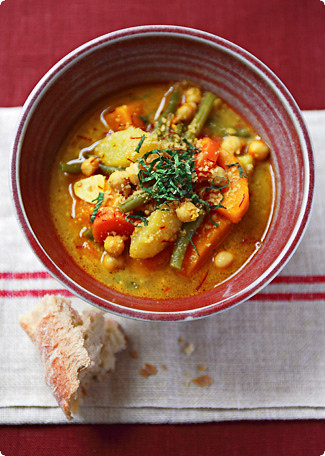
Olla Gitana (Gypsy Pot) 


There’s a piece of long-held wisdom in the culinary world that the true test of a cook’s abilities is not how well they can execute the most complex dish in their repertoire, but rather how well they can do the most basic one. When Gordon Ramsay, for instance, hosted a television series a while back in which he helped struggling restaurants to get back on their feet, the first thing he often did upon entering the kitchen was order the chef to make him a simple, no-frills egg and butter omelette. In typical Ramsay style the vast majority of them ended up going straight from his mouth to the trash (accompanied, of course, by a copious shower of expletives), but his point was more profound: if you can’t do the simple stuff well, you probably won’t be able to do anything well, and before any cook thinks of moving on to foie gras and caviar, that omelette needs to be perfect. While I certainly wouldn’t dream of arguing the principle (especially not with Gordon), when it comes to the specifics, I will admit to a slightly different view. Ramsay and his cronies can slave over all the perfectly crafted omelettes they want – from my perspective nothing cuts to the chase of kitchen competence like a bowl of plain old vegetable soup.

Having spent the better part of a decade as a vegetarian, I can safely say that I know vegetable soup pretty well. In fact, there were times in which I had little else to sustain me. One of these was during my first year in college, when like all other freshman students, I was under obligation to live in university housing and eat on their meal plan. The dining hall there was catered by a well-known national firm that lumped our service into their hierarchy of quality at grade F, otherwise known as ‘food for those in no position to complain, a.k.a. prisons and colleges’. Every day, along with the flabby, grey meat in one form or another and deep-fried fish or chicken patties, there would be a single vegetarian dish, most often a variation on some kind of vegetable soup. Next to this there was a selection of two or three boiled vegetables that rotated daily: peas, carrots, potatoes, lima beans, corn, green beans, broccoli. The interesting thing was that the daily soup special had mysterious correlations with what had been gracing the vegetable chafing dishes the day before: if peas and carrots had been on the menu, we could count on a watery tomato broth with peas, carrots and maybe a handful of pasta. Some days we could even trace the vegetable lineage back two or three days, with those peas and carrots sharing space with some very dilapidated lima beans or corn. I suppose they served vegetable soup because it seemed like a safe bet, not only cheap but ostensibly nutritious, and because it functioned as a catch-all for nearly every dietarily-challenged group that might pass through the dining hall doors: vegetarians, vegans, diabetics, dieters, wheat-, dairy- and just-about-everything-else-allergics. And while none of it could be mistaken for a highlight of my culinary existence, the experience did leave me with one valuable thing: a particularly keen eye for a GOOD bowl of vegetable soup.

Vegetable soup, unfortunately, is often seen either as a dumping ground for what is too old or tasteless to consume in any other form, or as a form of punishment from the school of ‘if it’s healthy, it must taste accordingly!’ philosophy. This couldn’t be further from the truth, however, and even without the addition of truffles, foie gras, or copious amounts of cream and cheese, a little care lavished on a pot of top-quality vegetables can turn out something extraordinarily delicious. Case in point: this delightfully-named concoction I stumbled across in Anya von Bremzen’s The New Spanish Table, a wonderful compendium of recipes that illustrate how Spanish cuisine is evolving at breakneck speed to become one of the freshest and most exciting in the world. The gypsy pot (or stew, as it’s more commonly translated) stems from the region of Murcia in southeastern Spain, and owes its name to two things: its notable lack of meat which links it with poverty, and its seemingly anarchic list of ingredients: pumpkin, pears, chickpeas, almonds, tomatoes, mint and saffron (and from this you get a good sense of what the Spanish think of gypsies). Ollas are, in fact, common fare throughout Spain, but most draw the line at a few vegetables, some beans and a chunk of meat or two for flavor – I’ve certainly never been served one that incorporated anything this daring.

I was, then, surprised to discover that this is no avant-garde reinterpretation of a traditional peasant stew – on the contrary, this bizarre and intriguing assortment of ingredients is as traditional as it gets for Murcian stew-makers, though naturally the precise recipe varies. What surprised me most, however, was how delicious it was. Rich, earthy, with the slightly sweet note imparted by the pears marrying perfectly with the dusky saffron and the unexpected clarity of mint, it somehow tastes even more delicious knowing you can go back for as many guilt-free bowlfuls as you like. And trust me, you’ll want to.

Not to mention that armed with this recipe, in any contest of cooking ability I’m now sure I would blow away the competition. That is, unless they’d want me to demonstrate my omelette-making skills as well—which are, I’m afraid, seriously in need of some work. 

Olla Gitana (Gypsy Pot)

Serves: 4-6
Source: slightly adapted from The New Spanish Table by Anya von Bremzen 

2 14-oz (400g) cans chickpeas, drained
1 fat carrot, peeled and thickly sliced
8 cups (2 l) rich chicken or vegetable stock
1 lb. (450g) pumpkin or butternut squash, peeled and cut into 1-inch (2.5-cm) chunks
10 oz. (280g) green beans, trimmed and cut into 1-inch
(2.5-cm) lengths
2 medium slightly underripe pears, peeled, cored and cut into 1-inch
(2.5-cm) chunks
coarse salt and freshly ground pepper
3 tablespoons olive oil
3 large garlic cloves, chopped
a handful of blanched almonds
1 medium onion, chopped
1 teaspoon sweet paprika (not smoked)
2 medium ripe tomatoes, finely chopped
1 pinch saffron threads, crumbled
2 teaspoons red wine vinegar, or more to taste
2 tablespoons slivered fresh mint

 
Combine the chickpeas, carrots and enough stock to come about 1 1/2 inches above the top in a large heavy pot and bring to a boil over medium heat. Add the pumpkin, green beans and pears and season with salt to taste. Bring to a simmer and cook uncovered until the vegetables have softened, about 15-20 minutes.

Meanwhile, heat the olive oil in a medium skillet over medium heat. Add the almonds and garlic and cook, stirring, until golden, about 2 minutes. Using a slotted spoon, transfer to a bowl, leaving behind as much oil as possible, and set aside. Add the onion to the skillet and cook until softened, about 5 minutes. Add the paprika and stir for a few seconds, add the tomatoes and a few tablespoons of the cooking liquid and cook until the tomatoes soften and reduce, about 7 minutes. Gently stir the tomato mixture and the saffron into the pot with the chickpeas.

Continue cooking until all the vegetables are very soft and the pumpkin is almost falling apart, 5-7 minutes longer, adding more broth if the stew seems too thick. Meanwhile place the fried garlic and almonds in a food processor or coffee grinder and grind until finely ground (you can also use a mortar and pestle). Stir in the vinegar, and add this to the pot with the chickpeas. Taste for seasoning, adding more salt, pepper and/or vinegar if necessary. Let the stew cool for about 10 minutes. Garnish with the mint and serve with lots of crusty bread.