List-Making for Dummies

374691183_5ea7794dff.jpg
Pão de Queijo (Brazilian Cheese Bread)


I am not what you would call the world’s most organized person. While thankfully hygiene standards don’t usually drop below a certain level in our household, mess is another matter entirely; at times I’ve wondered if I emit some kind of magnetic attraction for chaos as no matter how hard I try to keep things neat, tidy and in their rightful places, they never seem to stay that way. One of the prime examples of this (besides my half of the closet, and believe me, you do not want to go there) is my to-cook list for this very blog – or as I should more accurately say, my to-cook lists.

You see, once upon a time, back when this site was young and I knew that much of its continued success would depend on my being methodical and disciplined about coming up with new content, I bought myself a little notebook. In this notebook I intended to keep one centralized, comprehensive list of things I wanted to cook, including the random ideas that occasionally assault me as well as the many tempting recipes I run across in cookbooks and magazines, which I would be able to refer to whenever I needed inspiration. In addition, having a list would allow me to phase out my far less efficient system of flagging finds with bits of post-it notes or folding down page corners – both of which tended to result in more forgotten recipes than culinary epiphanies.

It actually went very well for a few months, and I dutifully documented every appetizing inspiration and tempting recipe I ran across, and even managed to make a few of them while I was at it. But as I might have predicted, my enthusiasm for this new system eventually began to wane; without even realizing it I started consulting my notebook less and less, and eventually it got itself placed in some pile of stuff that my dear chaos-phobic (i.e. German) husband in one of his I-can’t-take-this-mess-anymore fits relocated to some dark and invisible corner of our apartment.

Although I didn’t really miss the notebook itself, the problem was that I had gotten used to jotting down recipe references instead of marking their location at the source, and thus when the notebook disappeared I simply carried on writing those little notes on whatever paper I could find. Soon our apartment, in addition to drowning in cookbooks and food magazines, was awash with little bits of paper – backs of envelopes, torn corners of bank statements, margins of old shopping lists – enthusiastically reminding me to make Azeri Meatball Stew or some great new variation on eggplant parmesan. I even made a stab at locating the notebook when I realized what a mess I was making, but that failed – as did my half-hearted attempt to collect all those scraps of paper into a central scrap location, since I could never remember where it was. The end result of all this chaos, of course, was that unless a recipe was so phenomenally tempting and immediately do-able, chances are it would be noted, lost and forgotten long before it had a fighting chance to actually be made.

But as luck would have it, a couple of weeks ago I was rifling through a large stack of magazines and old mail in our living room – something I swear I’d done a hundred times already – looking for a misplaced utility bill, when something familiar slipped out: my old notebook.

Clutching it like a long-lost friend, I settled into the sofa and cracked it open, curious to see what exactly I had intended to cook a year or so ago. Inside was a long list of dishes, some of which I couldn’t for the life of me understand what had attracted me but most of which still sounded pretty good. A few even caused me to slap my forehead in disbelief – how could I have forgotten that one? The one that caused me the most head-slapping, however, was the entry at the very top of the list. This was something I’d been intending to make for so long that it was likely the very thing that compelled me to start keeping a list in the first place, in hopes that doing so would finally motivate me to cross it off. Unlike the rest of the list, this entry had no cookbook reference or involved description, just three simple words: pão de queijo. That was all the reminder I needed.

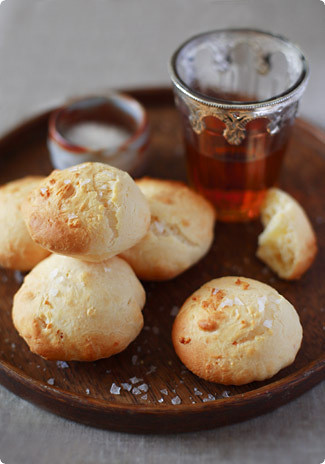
Pão de queijo literally translates from Portuguese as ‘cheese bread’, and though that’s essentially what these puffy little rolls are, the name only tells half the story. The first thing to know about pão de queijo is that the relationship Brazilians have with it borders on obsessive. In researching recipes I stumbled upon one by Valentina (also the author of Trembom), and in the headnotes she relates how she once joined a Brazilian online forum called ‘I’m crazy about pão de queijo’ which was dedicated to nothing else but discussing the merits of, and sharing recipes for, versions of this tasty snack. At the time she joined the forum had more than 200,000 members(!).

The second thing to know is that these little breads are fundamentally different from the majority of cheese-bready things around the world in that they are naturally and completely gluten-free. While they seem to be cousins to the French gougères in terms of technique and appearance, they’re made entirely with tapioca starch (the fine, white powder extracted from cassava roots), which gives them a texture quite unlike anything else. Their transformation is actually quite miraculous to watch: they go into a hot oven as lumpy, ragged little mounds with the consistency of spent chewing gum and emerge light as air, crusty around the edges and possessing a wonderful, toothsome chew. Brazilians, it seems, love to eat them for breakfast with coffee, though I’m just as inclined to nibble them with a pre-dinner drink, and they’d also be a great accompaniment to a hearty soup or stew, or could even be fancied up as party food with a stuffing of some kind.

Brazilians of the world, you are really onto a good thing here – though I’m sure you don’t need me telling you that this is one for the permanent recipe file. And speaking of that file – you know, that centralized, organized place I keep track of all the recipes I intend to make again – well, it’s about time I put one together, don’t you think? I’ll just have to put it on my list. 


Pão de Queijo

There seems to be widespread consensus that these are quite tricky to make, but I didn’t find this to be the case. One thing I would recommend is to measure the tapioca starch by weight if you can, which is infinitely more reliable than by volume. If you do measure by volume, note that I use the lightly-aerate-then-scoop-and-level method. In the recipe I’ve given some clues as to the texture you’re aiming for in the dough – the important thing to note is that it should not actually be firm enough to make balls, but rather soft, misshapen little mounds. If you’re worried, you can always test-bake a couple to see if they puff up like they should. As for the tapioca starch/flour, you should be able to locate some in an Asian or other ethnic market (where you might find it under the names yuca, manioc, cassava or polvilho azedo/doce, any one of which will fit the bill), or any place that stocks gluten-free baking supplies.

yield: 20-30 rolls, depending on size 
source: adapted from Valentina and other online sources

4 cups (500g) tapioca starch (aka polvilho, yuca, ma
nioc or cassava flour/starch), plus more if needed
1 1/2 teaspoons salt
1 1/2 cups (375ml) milk
1/2 cup (115g/125ml) unsalted butter or vegetable oil (oil is traditional, butter gives more flavor)
2 eggs, at room temperature
7oz (200g) finely-grated parmesan cheese

In the bowl of your heavy-duty stand mixer* combine the salt and tapioca starch. In a saucepan combine the milk and butter and bring to a boil, stirring occasionally to prevent scorching. Fit your mixer with the paddle attachment, turn on medium-low, and begin drizzling in the hot milk mixture. At first it will all clump up, but keep drizzling in, stopping and scraping down the bowl and paddle as necessary, until it comes together and forms a smooth, thick, gluey dough. Beat for a minute or two, then turn the mixer off, cover the bowl with a cloth and let rest for 15 minutes, or until just warm to the touch.

Preheat the oven to 425F/210C. When the dough has cooled down a bit, turn the mixer to medium speed and add the eggs one by one. When they are completely incorporated add the cheese and mix for another minute. The dough should have a sticky, stretchy consistency somewhat like spent chewing gum (but a little softer). It shouldn’t be firm enough to roll into balls, but it should be firm enough to hold its shape on a spoon. Add a bit more starch or a splash more milk if needed.

Line two large baking sheets with parchment paper. Using a well-greased spoon (or a couple of spoons, or a spoon and your hands – whatever works), drop mounds of dough about the size of unshelled walnuts onto the sheets, spacing them at least an inch (2.5cm) apart. Don’t worry if they are not perfectly shaped, or if the surfaces are not smooth – in the heat of the oven the irregularities will melt away. Bake them for about 20-25 minutes, rotating the baking sheets halfway, until they’ve puffed up nicely and are golden brown in spots. Remove immediately to cooling racks and allow them to cool slightly before eating. The recipes say to enjoy them warm, but I liked them at room temperature as well – the texture is slightly different but still very good.

(*I don’t think I’d trust a handheld mixer to confront this sticky, viscous dough and survive, but it can be mixed by hand in a large bowl with a sturdy spoon – just be prepared for a good workout!)


Far for the Soul

364914632_25a9b53d9a.jpg
Far Breton 

 
January, you make it hard for me to like you.

You come blowing in with your icy winds that howl around our rickety old windowpanes like angry ghosts, and your horizontal rain that stings like tiny icicles shot from the barrel of a gun. You bring darkness that lingers on the edge of the horizon all day, ready to pounce at the first sign of weakness from the sun. You bring no vacations to anticipate, no signs of Spring to herald, no reasons to rejoice. And worst of all – you make me hungry, and then you tell me not to eat.

Yes, I know I am as much to blame as you for falling into your trap, but once again I have embraced you as the month of betterment, repentance, and denial. That’s right, I have believed your magazine spin-doctors and your lifestyle gurus that tell me that the only thing standing between me and eternal health, happiness and a smaller swimsuit size is a little bit of self-discipline. So fueled by the guilt of Christmas and those oddly compelling things called ‘resolutions’, I have banished the fat and the sugar, the cream and cheese and chocolate from my life; I have reacquainted myself with that place called ‘gym’ and started running to it every time the urge to sink my mixer into a stick of butter threatens to overwhelm me. But even in my attempts to follow your path of righteousness you punish me, January, as it seems you have lead everyone and his uncle along the exact same path to that gym, and the only rewards I am given for my virtuousness are long wait times and the singular sensation of sweating in a sardine can.

But I still persist in believing that these sacrifices will be worth it in the end – which shows the terrifying extent of your power over me – and so I keep at it, battling the Lycra crowds, reinventing vegetables in every way possible, trying to make friends with cottage cheese and lowfat mayonnaise. Sometimes, though, no matter how steely I try to keep it, my resolve weakens, and on these dark days I wake up feeling that if I don’t cram my oven and my belly full of as much sugar, butter and vanilla as they will hold, I cannot be held responsible for the heinous crimes I will commit.

Luckily, January, I’m more clever than you think.

You see, I have a new trick up my sleeve, a sweet, tempting trick that satisfies the belly and the oven without the kind of long-term of damage to resolve this usually entails. It tastes gloriously rich and indulgent, its silky not-quite-custard-but-not-quite-cake texture interrupted here and there by fragrant little drunken fruits; its homely exterior offering no hint as to the sophistication inside. It also happens to have a funny little name, and an exotic pedigree which facilitates fabulous workplace daydreams involving craggy cliffs, quaint stone villages and ancient Celtic tongues. But most importantly, although under normal circumstances I am pathologically allergic to finding the word ‘diet’ and ‘dessert’ together in one place, I must point out that the relative paucity of naughty things in this particular little number means that when the last delicious crumb has been inhaled and the damages are tallied, the resolve, not to mention all those plans for self-improvement, are not so hard to put solidly back on track.

So, January, since you won’t be sticking around long enough to see whether all the promises and pipe dreams you’ve given me come true, I’ll just have to let you know next year. In the meantime, however, I’ve realized that even though you’ll hardly find me mourning your departure next week, I’m not feeling nearly as resentful of you as I expected — proof, no doubt, that a little Far Breton does wonders for our relationship.

Far Breton

I’m not sure what category of desserts this delicious and very traditional creation from Brittany belongs in – is it a cake or a custard? It’s certainly firm enough to slice and goes great with a cup of coffee, but its dense, smooth texture almost feels like something you should be licking off a spoon. Never mind, just give it a try – it’s really easy, really good and remarkably light. The traditional version calls for it to be studded with prunes soaked in brandy; actually Dorie’s recipe calls for raisins as well, which I left out – if you’re a raisin lover just add 1/3 cup to the pan with the prunes, and, oh, do your best to find those incredible French Agen prunes…they’re what quickly got me over my aversion to these poor, maligned fruits. I must say, though, that after trying it the ‘right’ way once the wheels are spinning on all the potential delicious variations out there. I know, I know, you don’t need to tell me I’m an abomination to authenticity! Dried cherries soaked in amaretto are at the top of my list to try next, for example, and maybe after that dried pears with sweet sherry. Authentic or not, though, this is sure to become a wintertime staple in our house.

Serves: 8
Source: slightly adapted from Baking, From My Home to Yours by Dorie Greenspan 

2 cups (500ml) whole/full-fat milk
3 large eggs
1/2 cup (110g) sugar
5 tablespoons (70g) unsalted butter, melted, cooled
1/2 teaspoon vanilla extract
1/4 teaspoon salt
3/4 cup (105g) all purpose flour

1 cup, packed (200g) pitted prunes (preferably pruneaux d’Agen)
1/2 cup (125ml) water
4 tablespoons (60ml) Armagnac or other brandy…or any other booze

Powdered/icing sugar, for dusting

Combine the milk, eggs, sugar, butter, vanilla, and salt in blender jar and blend for 1 minute. Add the flour and pulse just until blended, scraping down the sides of the jar. Cover and chill in the jar or in another container at least 3 hours and up to 1 day (I actually missed this part and only had 1 1/2 hours to let it chill, to no obvious detriment).

Combine the prunes and water in a heavy small saucepan. Simmer over medium heat until the fruit is softened and water is almost evaporated, stirring occasionally, about 10 minutes. Turn off the heat and transfer the prunes to a small bowl (discard any liquid remaining). Pour the brandy over, cover and cool completely.

Position a rack in the center of the oven and preheat to 375F/190C. Butter an 8-inch-diameter (20cm) cake pan with 2-inch-high sides (I think a 9-inch pan would also be just fine). Line the bottom with parchment paper and butter the paper. Dust the pan with flour, shaking out the excess; place it on the baking sheet.

Whisk the batter to reblend, tap it a couple of times on the counter to pop any large air bubbles, and pour it into the prepared cake pan (I actually whisked in the small amount of boozy liquid from the prunes before pouring the batter into the pan, since I couldn’t bear to waste it). Drop the prunes into the batter, distributing them as evenly as possible. Bake the far on the baking sheet until the top is puffed and brown and a knife inserted into the center comes out clean, about 1 hour (mine took about 50 minutes, but I was using convection). Cool the far completely in its pan on a rack.

Place a piece of parchment or waxed paper on a flat plate. Sift some powdered sugar onto the paper. Run a knife around the far to loosen it. Invert the pan onto the paper, shaking gently if needed to release it. Peel off the paper. Place a serving plate over the far and invert. Dust the top with additional powdered sugar and serve at room temperature.


Vegetable Love

358492735_129e3d977e.jpg
Cauliflower Risotto with Spicy Pangrattato 


As much as I pride myself on my broad culinary horizons, the truth of the matter is that I did not spring into existence with a perfectly formed palate. As a child, my list of dislikes was gargantuan: everything from beans to chicken to anything containing garlic was blacklisted at one time or another. The single greatest highlight of my young existence was a bland, soggy fast-food meal, and on a trip to New York City when I was eight, I amazed my parents by managing to locate a hamburger on the menu of each and every restaurant we dined in (and, perhaps more amazingly, never tired of them). My real nemesis, however – the thing that crept into my nightmares and caused me to wake up clammy and terrified – was vegetables. I loathed vegetables in every shape, size and color. The mere thought of raw tomatoes could make me gag, a face-to-face encounter with spinach left me feeling faint, and those little piles of limp broccoli I was forced to ingest before dessert negotiations could begin were as cruel a torture as my young mind could fathom. I hated all of them so much that I swore the first thing I would do when I was all grown up was to never touch a vegetable again (and presumably subsist on hamburgers for the rest of my life, but I don’t think I actually thought that part through).

Luckily, with maturity came more flexible tastebuds, and before too long beans and garlic and even far more exotic foods became regular interlopers on my plate. I was not quite as quick to make my peace with vegetables, but when I finally reached that age when I began to realize that other culinary attributes could be as important as taste (such as caloric value), I embraced vegetables with all the enthusiasm you reserve for those things you embrace because they’re good for you, not because they bring you any pleasure.

Then a few years later, just shy of my seventeenth birthday, I found myself in a peculiar position: as a vegetarian exchange student in Spain. Spain has been called one of the more difficult countries to avoid meat in, an assessment that may no longer be true but was certainly right on the mark in 1994. Lacking the pasta, the whole grains, the soy and tempeh and copious amounts of dairy my American diet had revolved around, I found myself left with a regimen of bread and vegetables. At home that might have been enough to make me reconsider carnivorism, but in Spain, contrary to all expectations, I thrived. Surprisingly, the variety of vegetables available was more or less the same as at home – maybe even slightly reduced – but under the deft touch of my Spanish host mother Clari, those familiar veggies took on new life. Some of them she sliced and fried crisp and light as air, while others she simmered or stewed until they were soft and succulent, liberally seasoned and drowned in garlic and olive oil. Even though they were always simple, earthy preparations, they were so novel to me, and so delicious, I felt like I could never get enough. I’ll never forget one of my first nights with my host family, when over a bowl of soft-as-silk cauliflower that had been buried under fistfuls of fried garlic and homemade mayonnaise, Clari turned to me and asked, ‘and how does your family prepare vegetables?’ When I told her we just steamed them or cut them into skinny sticks for dipping, she looked quite aghast. ‘That sounds kind of boring,’ she ventured, and it wasn’t hard for me to agree.

There were plenty of culinary epiphanies in store for me that year, but one of the greatest was what I learned about vegetables. Contrary to what I had grown up believing – that vegetables are the price you must pay for being healthy – in Spain, as in other countries around the Mediterranean, vegetables are not seen as penance but as celebration. Whether appearing in the fritters of Spain, the gratins of France, the mezze of Greece or the wonderful grain-based dishes of Italy, vegetables are revered for their inimitable spectrum of flavors, colors and textures. They are eaten fresh and in season or expertly preserved, and their innumerable preparations reflect the kind of no-nonsense ingenuity and imagination that centuries of poverty have inspired. While the now-well-known health benefits are recognized in these places too, it is essentially a bonus – first and foremost, vegetables are a pleasure.

As my parents are quick to remind me every chance they get, I’ve come a long way in the last twenty years. These days I’m not likely to turn up my nose at much of anything, and vegetables in one form or another find their way into most things I eat. But in all honesty, one thing really hasn’t changed – I still don’t want to eat vegetables just because they’re good for me. I want to eat them because they are delicious.


Cauliflower Risotto with Spicy Pangrattato 

I love, love, love this risotto – it truly reflects the genius of the Italians when it comes to vegetables. A whole head of cauliflower is melted into a pot of risotto, leaving behind no trace of its identity apart from a silkiness and subtle umami that many find hard to decipher. The other thing that sets this version apart from the usual is the crunchy, salty, spicy mixture of breadcrumbs, anchovies and chili that is showered over each serving, ‘kicking it up a notch’, if you will. Of course as in any risotto, the quality of your stock is key; now’s the time to break out the homemade article, or if that’s really not an option, source out the best your supermarket has to offer (but please, please don’t use bouillon cubes, unless your cubes come from some alternate universe where they’re actually good). Oh, and please do serve this risotto to your kids – though perhaps wait until they’ve downed their first enthusiastic forkful before telling them what’s in it.

Serves: 4 as a main dish, or 6 as a side
Source: slightly adapted from Jamie’s Italy, by Jamie Oliver

two large handfuls breadcrumbs, from a slightly stale country loaf (about 1 cup, packed)

1 flat can anchovies in olive oil, undrained
pinch or two of hot chili flakes, or to taste

about 5-6 cups (1.25-1.5l) chicken stock
1 medium head cauliflower (about 2lbs/1kg)

6 tablespoons (90g) butter, divided
2 tablespoons (30ml) olive oil
1 large onion, finely chopped
4 cloves garlic, finely chopped
2 cups (400g) carnaroli or arborio rice
1 cup (250ml) dry vermouth or white wine
1 tablespoon finely chopped rosemary
4 oz (115g/about 1 cup) freshly grated parmesan cheese
salt and freshly-ground black pepper
extra parmesan cheese, for serving

Combine the bread in a food processor with the anchovies, the oil from the can and the chili flakes and process to fine crumbs. Heat a frying pan with a splash of olive oil and sauté the crumbs over medium-high heat until browned and crispy. Set aside.

Bring the chicken stock to a simmer in a large saucepan. Tear the green leaves off the cauliflower and cut out the stalk. Chop the stalk finely and cut the florets into 1-inch pieces. Drop the florets in the pan with the stock, bring to a gentle boil, and cover.

In another, heavy-bottomed saucepan, heat 2 tablespoons butter and the olive oil over medium heat. Add onion, garlic, and reserved chopped cauliflower stalk and sauté until very tender, a
bout 15 minutes. Add the rice, stirring constantly to coat it with the oil. After about a minute the grains of rice should start to become translucent around the edges. Add the vermouth or wine, and stir constantly until it has been absorbed. Add a ladleful (about 1/2 cup) of the hot stock and a good pinch of salt, and again stir constantly until all the liquid is nearly absorbed before adding the next ladle of stock. Continue adding the stock bit by bit until the rice is about half cooked. By now the cauliflower florets should be very soft (this is important, so take the rice off the heat for a couple minutes if they’re not yet there). Start adding the florets in with the stock, crushing them into the rice as you go. Continue until the rice is cooked but still retains a gentle bite and the cauliflower has all been added. This should take about 18-20 minutes in total; if you find you run out of broth before the rice is cooked, add a bit of boiling water. The finished risotto should be pourable but not soupy; all’onda in Italian.

As soon as the rice is cooked, remove the pan from the heat and stir in the rosemary, parmesan cheese and remaining 4 tablespoons of butter. Cover the pan and let it sit undisturbed for 2 minutes (not longer or it will thicken too much). Taste for seasoning, and add salt and pepper to taste. Serve immediately in shallow bowls, topped with the crunchy pangrattato and additional parmesan.